A complete guide for new collectors
October 6, 2026 · 10 min read

Buying your first original artwork can feel exciting, personal, and slightly intimidating. You may love art but wonder whether you know enough to make a good decision. You may be unsure how prices are determined, what questions to ask an artist or gallery, how to evaluate quality, or whether a work that moves you emotionally is also a sensible purchase. The good news is that you do not need an art-history degree, a large budget, or years of collecting experience to begin. You need curiosity, patience, a little practical knowledge, and the confidence to trust your own response.
For a new collector, the best first purchase is not necessarily the most famous name, the most expensive piece, or the work someone else tells you will increase in value. It is the artwork that creates a meaningful connection while also meeting basic standards of authenticity, condition, provenance, price transparency, and suitability for your space.
The first step is simply to look. Visit galleries, browse curated online art platforms, explore artists’ studios, attend exhibitions, and spend time noticing which works make you stop. Your reaction may be immediate: a color combination may feel familiar, a portrait may seem to follow you, or an abstract composition may create a sense of calm, energy, tension, or joy.
Do not dismiss that emotional response. Art lives in your home long after the transaction is finished. You will see it in different light, at different times of day, and during different phases of your life. A strong personal connection matters.
At the same time, try to understand your own taste. Save images of works you like and look for patterns. Are you repeatedly drawn to figurative art, abstraction, landscapes, minimalism, expressive color, monochrome works, photography, sculpture, textile art, or mixed media? Do you prefer quiet works or dramatic statement pieces? Are you attracted to emerging artists or to more established names? The clearer your preferences become, the easier it is to make a confident first purchase.
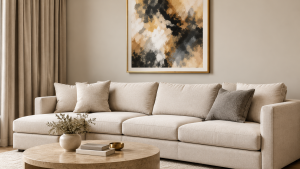
Before buying, consider the physical setting. Measure the wall or surface where the work may be placed. Note the width, height, available viewing distance, furniture underneath, natural light, ceiling height, and surrounding colors.
A common mistake is buying a work that feels large online but looks too small once it is installed. Another is choosing an oversized piece that overwhelms the room. As a general rule, art placed above a sofa, console, or bed often looks balanced when it occupies a substantial portion of the furniture width rather than floating as a small object in the center of a large wall.
Do not be afraid of scale, however. One strong original artwork can transform a room more effectively than several decorative objects. If the work is powerful enough, the room can be designed around it rather than the other way around.
Original art exists at many price points. New collectors sometimes assume that “real art” must cost tens of thousands of dollars, but many talented artists offer original works within accessible ranges.
Set a maximum budget before you begin seriously considering a purchase. Remember that the final cost may also include framing, shipping, insurance, customs duties, taxes, professional installation, or a protective crate for large works.
A budget should guide you, not prevent you from buying something meaningful. If a large painting by an artist is beyond your budget, consider a smaller original work, a work on paper, a study, or a limited edition. The goal is to begin collecting with confidence rather than to stretch yourself financially for the sake of prestige.
An original artwork is a unique work created by the artist. In painting, drawing, sculpture, textile art, and many mixed-media practices, there is usually only one original piece.
A limited edition is different. The artist produces a fixed number of authorized works, often in photography, printmaking, digital art, or certain sculptural practices. An edition may be marked, for example, 3/25, meaning the third work in an edition of twenty-five.
A reproduction is a copy of an existing artwork, often produced in larger quantities. Reproductions can be attractive and affordable, but they should not be presented or priced as unique original works.
Before buying, make sure the listing clearly states what you are purchasing. Terms such as “original,” “unique work,” “edition,” “artist proof,” “giclée,” and “print” should be used precisely.
You do not need to conduct an academic investigation, but it is useful to understand who created the work. Read the artist’s biography and statement. Look at other works from the same period or series. Check whether the artist has exhibited, received professional recognition, participated in residencies, worked with galleries, or developed a consistent body of work over time.
Consistency does not mean every artwork must look the same. It means there is evidence of serious artistic practice and development.
For emerging artists, the absence of a long exhibition history is not necessarily a problem. In fact, collecting artists early in their careers can be one of the most rewarding parts of collecting. What matters is authenticity, commitment, quality, and a body of work that feels intentional rather than random.
Art pricing can seem mysterious, but several factors usually contribute to the asking price. These may include the artist’s career stage, exhibition history, demand, size of the work, medium, complexity, production cost, scarcity, gallery representation, and previous sales history.
Within an artist’s own body of work, larger pieces often cost more than smaller ones, and certain media may require more time or expense. A unique painting is usually priced differently from a work produced in an edition.
Price alone is not proof of quality or future value. A higher price may reflect an established market, but it should not replace your own judgment. For a first purchase, focus on whether the price is clear, consistent with the artist’s broader market, and reasonable within your budget.
A professional art purchase should include clear documentation. For an original work, ask whether a Certificate of Authenticity is included. Ideally, the certificate identifies the artist, title, year, medium, dimensions, and unique status or edition number.
The invoice or sales receipt should also describe the artwork accurately. Keep all documentation together after the purchase.
For higher-value works, provenance becomes increasingly important. Provenance is the documented ownership and history of the artwork. For a work purchased directly from a living artist or a reputable primary-market gallery, provenance is usually straightforward. For older or secondary-market works, it may require more careful verification.
Ask what the artwork is made from and whether the materials require special care. A painting on canvas may be ready to hang or may need framing. A work on paper usually requires protection behind appropriate glazing. Photography may be printed on archival paper, aluminum, acrylic, or another surface. Sculpture may have specific weight, installation, and handling requirements.
If the work is not new, request a condition report or clear photographs showing the surface, corners, frame, and reverse. Small imperfections are not always a problem, especially with handmade work, but they should be disclosed.
Also consider the environment where the work will be displayed. Direct sunlight, humidity, heat, and moisture can affect artworks over time.
The frame is not just a border; it influences how the artwork is experienced. Some works are intentionally unframed, while others benefit enormously from professional framing.
If a work is already framed, confirm whether the frame is included in the listed dimensions and price. For works on paper, ask whether archival materials have been used. For heavy works or sculptures, make sure your wall, shelf, or floor can safely support the piece.
When hanging artwork, the center of the work is often positioned near average eye level, but the correct height depends on the room and surrounding furniture. A professional installer can be worthwhile for large, valuable, heavy, or unusually shaped pieces.
Buying original art online has made collecting far more accessible, but the quality of the buying experience depends on transparency.
Look for detailed photographs, including full views and close-ups. The listing should provide accurate dimensions, medium, year, framing status, edition information if relevant, shipping origin, and availability. Room-view images can help with scale, but remember that digital mockups are illustrative and may not represent exact proportions or colors.
Review the platform’s payment security, shipping process, return policy, buyer protection, and contact information. A reputable platform should make it easy to understand what happens after payment, how the artwork is packed, when it is shipped, and what happens if it arrives damaged.
Original art is not an ordinary parcel. Proper packing is part of the purchase.
Small and medium works may be shipped in reinforced art boxes, while large paintings or fragile works may require custom crates. Sculptures and works with glass may require specialized handling.
Confirm whether shipping is insured and what the insurance covers. Find out who is responsible for filing a claim if damage occurs during transit. Photograph the package before opening it if there are visible signs of damage, and document the unpacking process for valuable works.
International purchases may involve customs duties, import taxes, or local VAT. These costs can vary by destination, so buyers should understand whether they are included in the checkout price or collected separately upon import.
It is reasonable to consider the long-term value of an artwork, but predicting which artists will appreciate significantly is difficult. Art markets can change, and there is no guaranteed return.
A healthier approach is to buy art primarily because you want to own and live with it. If the artist’s career grows and the market value increases, that is an additional benefit.
If investment is a major objective, the decision requires deeper research into the artist’s market, gallery representation, auction history, institutional recognition, edition sizes, provenance, and broader collector demand. That is different from buying a first artwork for your home.
Collecting becomes more interesting when it is not treated as a one-time retail transaction. Follow the artist’s development. Attend future exhibitions. Learn about new series. Ask thoughtful questions.
Many collectors discover that their relationship with an artist’s work deepens over time. They may begin with one modest piece and later acquire a larger work as the artist’s practice evolves.
A good gallery, curator, or art platform can also become a valuable guide. The best advisors do not simply push the most expensive work; they listen to your taste, budget, space, and goals and help you discover artists you may not have found on your own.
There is no prize for building a collection quickly. A thoughtful collection develops over time.
Your first purchase teaches you what matters to you: scale, color, medium, subject, framing, artist story, and the experience of living with original work. Your second purchase will be informed by the first, and your taste will continue to evolve.
It is perfectly acceptable to walk away from a work, think about it, and return later. At the same time, remember that unique works can only be sold once. If a piece creates a strong connection, fits your budget, and passes the practical checks, waiting indefinitely can mean losing it.
Before completing your purchase, confirm the following:
• You genuinely like the artwork and can imagine living with it.
• You know the exact dimensions.
• You understand the medium and materials.
• You know whether it is an original, a limited edition, or a reproduction.
• The artist and seller are clearly identified.
• The price and any additional costs are transparent.
• You know whether framing is included.
• You understand the shipping method and insurance.
• You have reviewed the return and damage policy.
• You will receive an invoice and, where appropriate, a Certificate of Authenticity.
• You understand any import taxes or customs charges that may apply.
• The work is suitable for the intended space and environment.
The most important thing to remember is that collecting art is personal. Your collection does not have to impress experts or follow trends. It should reflect your eye, your experiences, your curiosity, and the artists whose work you believe deserves a place in your life.
Original art brings something into a space that mass-produced decoration cannot: the presence of another person’s imagination, choices, skill, and creative history. You are not simply buying an object for a wall. You are choosing to live with an idea, a moment, and a unique human expression.
Start with one work. Learn its story. Notice how it changes your room and how your relationship with it changes over time. Then keep looking.
The best collections are not built by people who knew everything at the beginning. They are built by people who kept paying attention.
A practical guide for anyone taking the first step into collecting original art.